
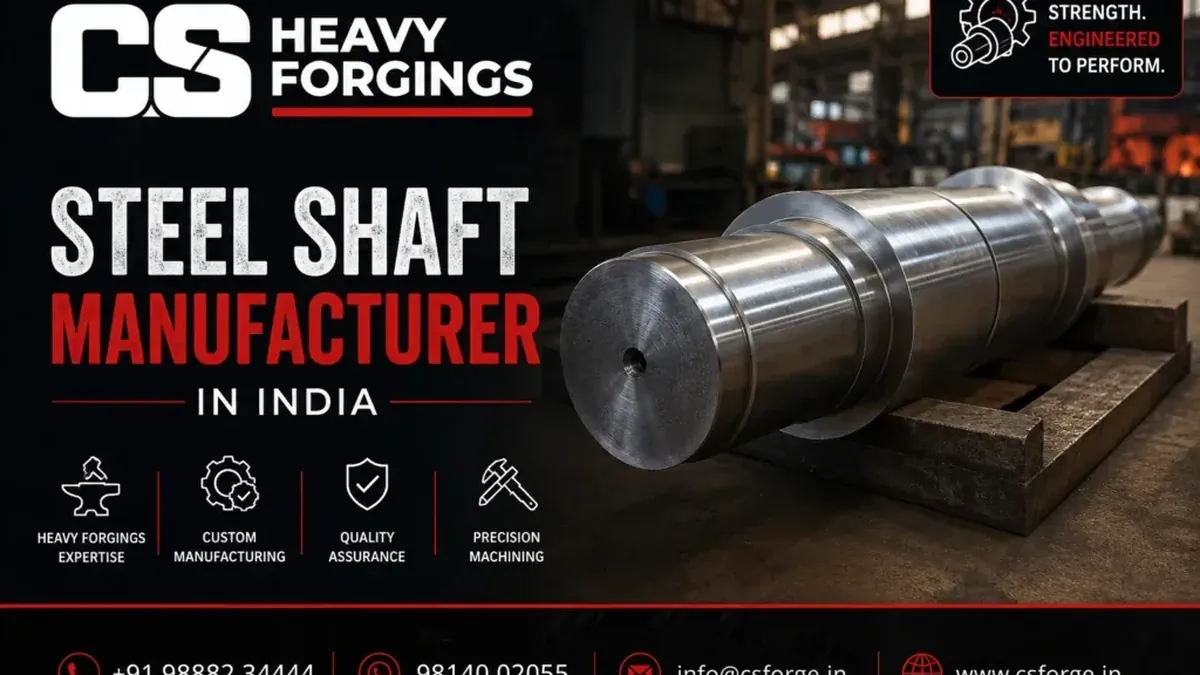
Finding the right steel shaft manufacturer is not simply about comparing shaft diameter, price per kilogram or delivery time. For rolling mills, steel plants, cement plants, power equipment and other heavy industrial machinery, a shaft can be a critical component responsible for transmitting torque, supporting rotating loads and operating continuously under demanding conditions.
That means the purchasing decision should begin with the component drawing, material requirement, service conditions and inspection criteria.
CS Heavy Forgings, based in Mandi Gobindgarh, Punjab, manufactures heavy forged steel shafts for industrial requirements across India. Its published steel shaft capability covers diameters from 125 mm to 700 mm, lengths up to 7000 mm and individual piece weights from approximately 200 kg to 12 tonnes.
This guide explains what industrial buyers should consider when selecting a steel shaft manufacturer, how heavy forged shafts are produced, what information should be included in an RFQ and which quality checks may be relevant before dispatch.
What Is a Forged Steel Shaft?
A forged steel shaft is a power-transmitting or load-bearing component produced by deforming heated steel into a required shaft blank before heat treatment, machining and final inspection.
The forging stage distinguishes it from a shaft manufactured only by machining a standard bar.
For heavy components, forging allows the manufacturer to develop the starting material closer to the required shaft geometry. This can be particularly useful for:
- Large-diameter shafts
- Long shafts
- Heavy piece weights
- Stepped shafts
- Drive shafts
- Roller and mill shafts
- Custom industrial shafts
A 50 mm machinery shaft and a multi-tonne rolling-mill shaft may perform similar basic functions, but they require completely different manufacturing facilities.
A heavy forged shaft may require large steel ingots, controlled heating, open-die forging, heat treatment, heavy machining equipment and specified non-destructive testing before it is ready for use.
When Should You Choose a Forged Shaft?
Not every steel shaft needs to be forged.
For smaller standard diameters and moderate service requirements, machining directly from commercial bar stock can be practical.
Forging becomes especially relevant when the component is:
- Large in diameter
- Long or heavy
- Subjected to demanding loads
- Required in a custom geometry
- Manufactured from specific engineering grades
- Intended for critical industrial machinery
- Required with controlled heat treatment and testing
Consider a stepped drive shaft that has several different diameters.
Producing the complete part from a single oversized round bar could mean removing a large quantity of steel during machining. A forged blank can instead be developed closer to the required stepped shape, reducing unnecessary material removal while leaving sufficient machining allowance.
The best production route should always be decided from the actual drawing rather than a general rule.
Forged Steel Shaft vs Machined Bar Shaft
| Factor | Forged Steel Shaft | Machined Bar Shaft |
|---|---|---|
| Large diameters | Well suited | Depends on available stock |
| Heavy piece weights | Suitable | Stock availability may limit size |
| Custom stepped geometry | Can be developed during forging | Requires greater stock removal |
| Heavy industrial applications | Commonly used | Application dependent |
| Material utilisation | Shape can be developed closer to requirement | More machining may be necessary |
| Custom low-volume components | Suitable for heavy engineering | Depends on stock dimensions |
| Manufacturing route | Forging, heat treatment, machining and testing | Primarily machining |
Neither option is automatically better.
The correct decision depends on:
- Material grade
- Shaft dimensions
- Quantity
- Mechanical properties
- Geometry
- Machining allowance
- Operating loads
- Service conditions
How Heavy Forged Steel Shafts Are Manufactured
A reliable industrial shaft is created through a complete manufacturing route. Buyers should understand this route instead of evaluating only the appearance of the finished machined component.
CS Heavy Forgings’ published shaft manufacturing process includes steel ingot production, heating and forging, heat treatment, rough machining, precision machining and final inspection/testing.
1. Drawing and Technical Review
The process should begin with the latest customer drawing.
A steel shaft manufacturer needs to review:
- Finished diameter
- Maximum forged diameter
- Overall length
- Step dimensions
- Material grade
- Quantity
- Approximate component weight
- Heat-treatment condition
- Machining allowance
- Mechanical properties
- Hardness requirement
- Dimensional tolerances
- NDT requirements
- Applicable standard
Suppose your shaft requires a finished bearing seat of 350 mm.
The forging normally cannot simply be produced at exactly 350 mm because sufficient machining allowance must remain for surface cleanup, dimensional correction and final machining.
Agreeing these details before forging reduces confusion later.
2. Starting Material and Traceability
The quality of a forged shaft begins with the steel used to manufacture it.
CS Heavy Forgings’ published process begins with steel ingots, which are then heated and forged into the required component shape.
Where traceability is required, the manufacturer should be able to maintain identification between:
Starting steel → Forging → Heat treatment → Testing → Finished component
For industrial buyers, this becomes particularly important when material certificates and inspection documentation form part of the purchase specification.
3. Heating and Forging
The starting steel is heated to a suitable forging temperature for the selected grade and section size.
During forging, the heated material is mechanically worked to develop the required dimensions and shaft geometry.
Large heavy shafts are commonly associated with open-die forging, where the workpiece is progressively shaped rather than completely enclosed inside a fixed die cavity.
Typical operations may include:
- Drawing
- Cogging
- Upsetting
- Stepping
- Shouldering
- Straightening
A straight shaft may require controlled drawing to achieve the specified length and diameter.
A stepped shaft may need additional forging operations to develop different sections before machining.
For a detailed explanation of process selection, read our guide on open die forging vs closed die forging.
4. Heat Treatment
Forging develops the component shape, but the manufacturing process does not necessarily end there.
Depending on the steel grade and engineering specification, a shaft may require heat treatment to develop its required mechanical properties.
Potential routes can include:
- Annealing
- Normalising
- Hardening and tempering
- Stress relieving
The correct cycle depends on factors such as:
- Material composition
- Component size
- Required strength
- Required hardness
- Toughness
- Final application
For example, a transmission shaft experiencing repeated torque may need a different property balance from a low-speed shaft carrying primarily static loads.
The heat-treatment requirement should therefore come from the specification, not from a generic process applied to every shaft.
5. Rough and Precision Machining
CS Heavy Forgings’ published process includes both rough machining and precision machining.
Machining removes forging scale and excess material while developing the required dimensions and surfaces.
A shaft may potentially be supplied in different conditions depending on the agreed scope, such as:
- Forged condition
- Rough machined
- Semi-finished
- More fully machined
The exact supply condition should be confirmed in the quotation and purchase order.
Machining allowance is particularly important.
Too little allowance can create problems during final machining, while excessive allowance increases material consumption, machining time and cost.
Steel Shaft Manufacturing Capability
A buyer sourcing a large shaft should verify whether the manufacturer can realistically handle the required dimensions and piece weight.
CS Heavy Forgings publishes the following steel shaft manufacturing range:
| Parameter | Published Capability |
|---|---|
| Shaft diameter | 125 mm to 700 mm |
| Length | Up to 7000 mm |
| Piece weight | Approx. 200 kg to 12 tonnes |
| Product type | Heavy forged steel shafts |
| Production route | Forging, heat treatment, machining and inspection |
These figures provide a useful initial capability reference.
However, a shaft should still be reviewed against its complete drawing because maximum diameter, length, material grade, total weight and geometry can affect manufacturability.
You can explore CS Heavy Forgings’ broader range of forged products including forged rolls, rings, flanges, die blocks and other heavy industrial components.
What Steel Grades Are Used for Forged Shafts?
There is no single steel grade suitable for every shaft.
The current CS Heavy Forgings shaft page identifies EN Grade, F Grade and D Grade forged steel shafts, with additional grade-specific shaft information available on the website.
Material selection should be based on engineering requirements such as:
Torque and Load
Higher loads may require greater strength or different heat-treatment properties.
Fatigue
Rotating shafts can experience millions of load cycles during their operating life.
Fatigue behaviour therefore matters in addition to static tensile strength.
Impact Loading
Equipment such as mills, crushers and heavy process machinery can introduce shock loading.
Wear
Bearing seats, gears, couplings and other interfaces may create specific hardness or wear requirements.
Operating Temperature
Service temperature can influence both material selection and heat treatment.
Corrosion
Some applications may require increased corrosion resistance depending on the operating environment.
Instead of selecting a grade only because “we used it last time,” send the operating requirements and drawing to the manufacturer for technical review.
Types of Industrial Steel Shafts
Straight Shafts
Straight shafts have a relatively consistent diameter and may be used in rotating machinery, support systems and power-transmission assemblies.
Stepped Shafts
A stepped shaft contains several different diameters.
Larger and smaller sections may accommodate:
- Bearings
- Gears
- Couplings
- Hubs
- Journals
- Roll bodies
Drive Shafts
Drive shafts transfer rotational power between components.
Their design can be influenced by:
- Torque
- Speed
- Alignment
- Connection type
- Service duty
Pinion and Gear-Related Shafts
These are commonly used in mechanical power-transmission systems where gears and shaft functions are closely connected.
Mill and Roller Shafts
Rolling mills, steel plants and process industries can use heavy shafts connected to rolls, drives, gear systems and related machinery.
Custom Forged Shafts
Many heavy engineering requirements are not standard catalogue products.
Custom shafts can be produced according to:
- Customer drawings
- Required dimensions
- Material specifications
- Heat-treatment requirements
- Machining requirements
- Testing criteria
Industries That Use Heavy Forged Steel Shafts
CS Heavy Forgings’ current shaft page identifies forged-shaft applications across several industrial sectors.
Steel Plants and Rolling Mills
Potential applications include heavy drive, mill, roller and transmission-related shaft requirements.
These components often work under continuous loading, vibration and demanding operating cycles.
Power Generation
Large rotating equipment can require shafts manufactured according to defined mechanical properties, dimensions and inspection requirements.
Mining
Mining and material-processing equipment can expose shafts to heavy mechanical loads and severe operating conditions.
Cement Industry
Cement plants use large mechanical drive and process equipment where heavy shafting may form part of the transmission system.
Marine Applications
Marine rotating equipment can use various heavy shaft components depending on the machinery design.
Oil & Gas
Certain heavy industrial systems within the sector may require forged shaft components manufactured to defined material and testing requirements.
Heavy Engineering
Custom shafts are used across machinery, transmission equipment and specialised engineering systems.
You can explore additional application areas on the industries served page.
Testing and Quality Inspection of Forged Steel Shafts
A reliable steel shaft manufacturer should be able to explain how the component will be inspected.
CS Heavy Forgings’ published shaft page lists the following quality checks:
- Chemical analysis
- Mechanical property testing
- Ultrasonic testing
- Hardness testing
- Dimensional inspection
- Surface examination
- Traceability verification
Each check has a different purpose.
Chemical Analysis
Confirms whether the material chemistry corresponds with the specified grade.
Mechanical Property Testing
Can be used to verify properties required by the specification.
Hardness Testing
Helps confirm the condition achieved after heat treatment.
Ultrasonic Testing
UT can be used to evaluate internal discontinuities where required by the applicable specification.
Dimensional Inspection
Confirms critical shaft dimensions against the drawing or agreed machining condition.
Surface Examination
Used to evaluate the surface condition of the component.
Traceability Verification
Helps connect the finished shaft with its material and manufacturing records where required.
Not every order requires every test. Buyers should specify the required inspection plan at the enquiry stage.
Common Causes of Industrial Shaft Problems
A shaft can experience problems even when the material itself is strong.
Potential causes include:
- Fatigue
- Excessive torque
- Bending overload
- Misalignment
- Stress concentration
- Incorrect material selection
- Inappropriate heat treatment
- Surface damage
- Internal discontinuities
- Improper machining transitions
- Bearing-related loading
- Corrosion
- Unexpected operating conditions
Consider a shaft with an abrupt transition between two diameters near a heavily loaded bearing position.
The material grade might meet the specification, but poor geometry can still create a local stress concentration.
Similarly, a correctly manufactured shaft can be damaged by installation misalignment that introduces additional bending forces.
Reliable shaft performance therefore depends on the complete system:
Design + Material + Forging + Heat Treatment + Machining + Inspection + Installation + Operation
What Should You Send to a Steel Shaft Manufacturer?
A detailed RFQ saves time for both buyer and manufacturer.
Whenever possible, provide:
- Latest drawing
- Drawing revision
- Steel grade
- Finished dimensions
- Maximum diameter
- Overall length
- Approximate weight
- Quantity
- Heat-treatment condition
- Required mechanical properties
- Hardness requirement
- Machining condition
- Machining allowance
- Dimensional tolerances
- NDT requirements
- Applicable specification
- Required documentation
- Delivery location
Instead of sending:
“Need two steel shafts of 400 mm diameter. Send best price.”
send something closer to:
“Two forged drive shafts required as per attached drawing. Maximum forged diameter 400 mm. Material grade and heat treatment as specified. Rough machining and UT required according to purchase specification.”
The second enquiry gives the manufacturer enough information to perform a meaningful technical review.
What Determines Forged Steel Shaft Price?
Heavy custom shafts normally cannot be priced accurately from diameter or weight alone.
The quotation can depend on:
- Steel grade
- Starting ingot requirement
- Forged dimensions
- Finished dimensions
- Piece weight
- Quantity
- Shaft geometry
- Material yield
- Heat treatment
- Rough machining
- Precision machining
- Mechanical testing
- NDT
- Documentation
- Inspection
- Packing
- Delivery
Two shafts weighing roughly the same can therefore have different manufacturing costs.
A complex stepped shaft requiring extensive machining and testing may cost more than a simpler straight shaft of similar finished weight.
For custom heavy forgings, the drawing should be the basis of the quotation.
Steel Shaft Manufacturer in Mandi Gobindgarh
CS Heavy Forgings operates from Mandi Gobindgarh, Punjab, a major steel and engineering manufacturing centre.
For buyers searching for a steel shaft manufacturer in Mandi Gobindgarh, location can support easier coordination with an established industrial supply chain.
However, location alone should never decide a purchase.
Buyers should still evaluate:
- Manufacturing capacity
- Material experience
- Forging process
- Heat treatment
- Machining
- Testing
- Documentation
- Traceability
- Delivery capability
Learn more about CS Heavy Forgings and its heavy-forging operations.
Steel Shaft Manufacturer in Punjab
For buyers looking for a steel shaft manufacturer in Punjab, technical capability should remain the main selection criterion.
A rolling-mill shaft, for example, may require completely different dimensions, properties and inspection from a shaft used in cement or heavy machinery.
The correct manufacturer should be able to review the individual drawing and determine whether the component fits its current forging, heat-treatment, machining and inspection capabilities.
Steel Shaft Manufacturer in India
CS Heavy Forgings manufactures heavy forged steel shafts for industrial requirements across India.
Customers can submit drawings containing their required:
- Material grade
- Shaft dimensions
- Quantity
- Heat treatment
- Mechanical properties
- Machining condition
- Testing requirements
- Delivery details
When sourcing a large industrial shaft, compare manufacturers on technical capability, quality verification, traceability, machining scope and delivery reliability, rather than evaluating only the lowest price per kilogram.
How to Choose the Right Steel Shaft Manufacturer
Before placing your purchase order, ask these questions.
Can the manufacturer handle the required size?
Check diameter, length, geometry and piece weight.
Has the supplier handled similar components?
Relevant manufacturing experience can make process planning more effective.
Can the specified material be processed?
Confirm material capability rather than assuming every forging manufacturer handles every grade.
What heat treatment is proposed?
The route should match the material and required properties.
What testing is included?
Clarify UT, mechanical testing, hardness and other inspection requirements before quotation.
How is traceability handled?
Critical components may require documented connection between raw material, manufacturing and final inspection.
What machining condition will be supplied?
As-forged, rough-machined and precision-machined components represent very different scopes.
What documents will be provided?
Specify certificates and inspection reports in the purchase requirement.
What is the actual production lead time?
A realistic schedule should consider material, forging, heat treatment, machining, testing and final inspection.
Why Choose CS Heavy Forgings for Heavy Steel Shafts?
CS Heavy Forgings specialises in heavy industrial forgings from its manufacturing base in Mandi Gobindgarh, Punjab.
Its published forged steel shaft capability includes:
- 125 mm to 700 mm diameter
- Lengths up to 7000 mm
- Individual weights from approximately 200 kg to 12 tonnes
- Heat treatment
- Rough machining
- Precision machining
- Inspection and testing
The company also manufactures other heavy forged products such as steel ingots, forged rolls, rings, discs, blocks and custom industrial components.
For commercial shaft requirements, you can also visit the dedicated Forged Steel Shafts Manufacturer in India page.
Frequently Asked Questions
What is a forged steel shaft?
A forged steel shaft is produced by shaping heated steel through forging before subsequent heat treatment, machining and inspection as required.
What size forged steel shafts does CS Heavy Forgings manufacture?
The published capability covers approximately 125 mm to 700 mm in diameter, lengths up to 7000 mm and individual component weights from 200 kg to 12 tonnes.
What tests can be performed on forged steel shafts?
The company’s published shaft page lists chemical analysis, mechanical testing, ultrasonic testing, hardness testing, dimensional inspection, surface examination and traceability verification.
What industries use forged steel shafts?
Applications include power generation, steel plants, rolling mills, mining, marine, oil & gas, cement and heavy engineering.
What information is needed for a steel shaft quotation?
Provide the latest drawing, steel grade, dimensions, quantity, heat treatment, machining requirements, testing requirements and delivery location.
Can forged shafts be manufactured according to customer drawings?
Custom heavy shafts can be reviewed against customer drawings, dimensions, machining allowances, heat-treatment requirements and material specifications.
Where is CS Heavy Forgings located?
CS Heavy Forgings is based in Mandi Gobindgarh, Punjab, India.
Request a Technical Review of Your Steel Shaft Drawing
If you are sourcing a heavy forged shaft for a rolling mill, steel plant, cement plant, power application, mining equipment or another industrial machine, begin with the drawing.
Share your:
- Material grade
- Shaft dimensions
- Quantity
- Heat-treatment requirements
- Machining condition
- Testing specification
- Delivery requirement
Contact CS Heavy Forgings to discuss your steel shaft requirement and request a technical review and quotation.