
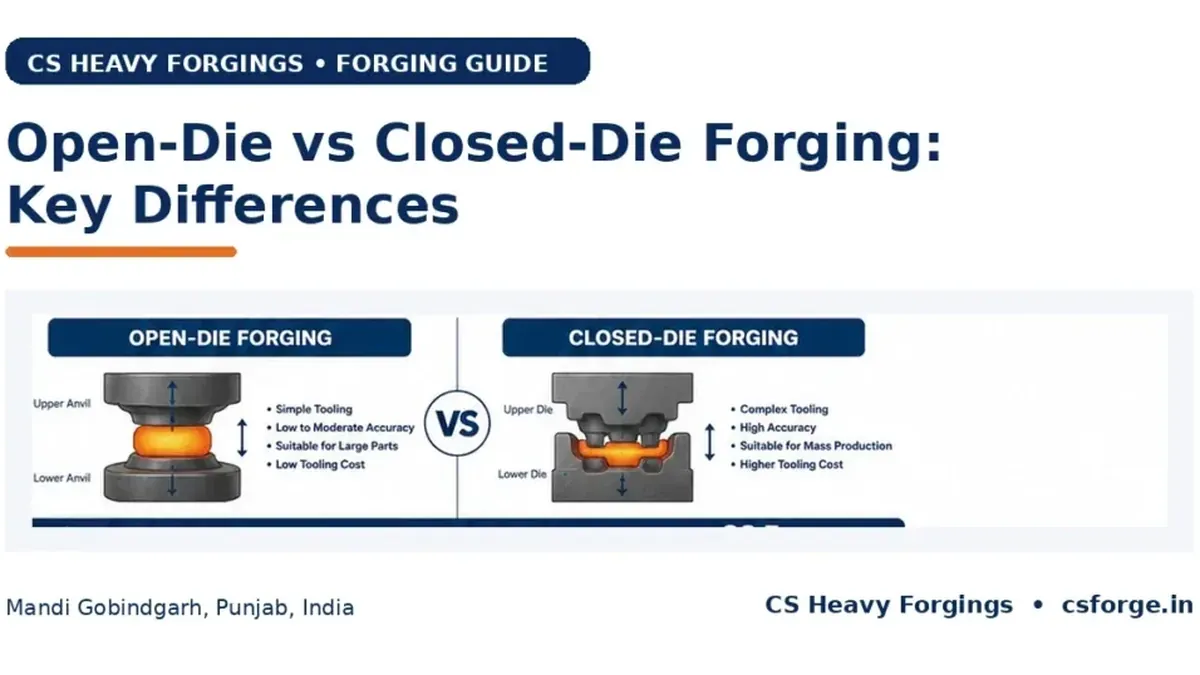
Choosing the right forging method can have a major impact on component strength, dimensional accuracy, tooling cost, production volume and overall manufacturing efficiency. Two of the most widely used metal-forming methods are open die forging and closed die forging.
Understanding open die forging vs closed die forging is especially important for steel plants, rolling mills, heavy engineering companies, machinery manufacturers, automotive suppliers and other industries that require high-strength forged components.
CS Heavy Forgings operates from Mandi Gobindgarh, Punjab, and specializes in industrial forging solutions including open die press forging for demanding engineering applications.
This guide explains the differences between open-die and closed-die forging, including their manufacturing processes, tooling requirements, component sizes, tolerances, production volumes, applications and selection criteria.
What Is Open Die Forging?
Open die forging is a metal-forming process in which heated metal is compressed between flat or relatively simple dies that do not completely enclose the workpiece.
The operator or forging system progressively manipulates the material between repeated press or hammer strokes until the required shape and dimensions are achieved.
Because the material is not fully enclosed inside a die cavity, the process provides considerable flexibility in producing large and custom-shaped components.
Open die forging is commonly used for components such as:
- Forged shafts
- Forged rolls
- Rings
- Discs
- Blocks
- Large round bars
- Step shafts
- Heavy machinery components
- Custom industrial forgings
CS Heavy Forgings’ existing product portfolio includes heavy forged items such as shafts, forged rolls, rings, bars, die blocks, cranks, step rolls, bobblers and other industrial components.
Main Advantages of Open Die Forging
Open die forging provides several important advantages for heavy engineering applications.
The process accommodates very large components and offers flexibility when manufacturing custom sizes or relatively low quantities. Because the dies are simpler than impression dies, initial tooling costs are generally lower.
Repeated deformation can also promote favorable grain flow and refine the internal structure of the material when the forging process is properly engineered.
The main benefits include:
- Suitable for large and heavy components
- Lower initial tooling investment
- Flexible dimensions and geometries
- Practical for prototypes and smaller production runs
- Strong mechanical properties
- Suitable for custom industrial forgings
- Easier modification of dimensions during development
For this reason, open die forging is widely associated with heavy engineering, rolling mills, power equipment, steel plants, mining machinery and industrial manufacturing.
What Is Closed Die Forging?
Closed die forging, also known as impression die forging, forms heated metal between dies containing pre-machined impressions of the required component.
When the upper and lower dies come together, the metal flows into the shaped cavities. Depending on the process design, excess material may form controlled flash around the component, which is removed during subsequent operations.
Because the die cavity defines the component geometry, closed die forging can achieve significantly greater repeatability and closer dimensional control than conventional open die forging.
It is commonly used for components such as:
- Connecting rods
- Automotive components
- Small gear blanks
- Levers
- Flanges
- Brackets
- Hand tools
- Agricultural components
- Complex industrial parts
Main Advantages of Closed Die Forging
Closed die forging is particularly effective when a manufacturer needs a large number of components with consistent geometry.
Its primary benefits include:
- High dimensional repeatability
- Capability for relatively complex shapes
- Reduced machining requirements in suitable applications
- Good surface consistency
- Efficient high-volume production
- Consistent component-to-component geometry
- Potentially lower unit manufacturing cost at sufficient volumes
However, creating precision die cavities involves significantly higher tooling design and manufacturing costs.
Open Die Forging vs Closed Die Forging: Comparison
The most important difference between the two processes is how the workpiece interacts with the dies.
In open die forging, the material is not completely enclosed. In closed die forging, the workpiece is formed within shaped die impressions.
| Comparison Factor | Open Die Forging | Closed Die Forging |
|---|---|---|
| Die Design | Flat or relatively simple dies | Precision-shaped die cavities |
| Workpiece Enclosure | Not completely enclosed | Formed within die impressions |
| Component Size | Ideal for large/heavy components | Generally smaller to medium components |
| Shape Complexity | Simple to moderately complex | Complex shapes possible |
| Tooling Cost | Lower | Higher |
| Production Volume | Low to medium | Medium to very high |
| Dimensional Accuracy | Moderate | Higher |
| Machining Allowance | Usually greater | Often lower |
| Setup Flexibility | High | Lower after tooling is finalized |
| Repeatability | Moderate to high with process control | Very high |
| Prototype Suitability | Excellent | Less economical |
| Typical Applications | Shafts, rolls, rings, discs, blocks | Connecting rods, gears, brackets, smaller flanges |
| Best Economic Use | Large/custom low-volume forgings | Repetitive high-volume production |
Difference in the Forging Process
Open Die Forging Process
A typical open die process includes:
1. Raw material selection
The appropriate steel grade and starting stock or ingot are selected according to the required mechanical properties and end application.
2. Heating
The material is heated to the required forging temperature.
3. Forging
The heated workpiece is progressively compressed and manipulated under the forging press or hammer.
4. Intermediate dimensional control
Dimensions are monitored throughout the forging operation.
5. Heat treatment
Depending on material grade and service requirements, heat treatment can be performed to develop the required mechanical properties.
6. Machining
Additional machining brings the component to its final dimensional requirements.
7. Inspection and testing
Chemical, mechanical, dimensional and non-destructive testing can be performed according to customer specifications.
CS Heavy Forgings describes a controlled manufacturing approach involving raw-material selection, heating, open-die forging, heat treatment, machining and inspection for its open-die products.
Closed Die Forging Process
Closed die forging generally begins with engineered die design.
A billet or preform is heated and positioned between matched dies. The press or hammer forces the material into the die impressions until the required geometry is formed.
After forging, trimming, heat treatment, cleaning, inspection and machining may be performed depending on the component.
Because dedicated dies must be designed and manufactured before production begins, preparation takes more time and requires greater initial investment.
Component Size and Production Volume
Component size is one of the strongest factors when comparing open die forging vs closed die forging.
Open Die Forging
Open die forging is particularly suitable for:
- Large diameters
- Long shafts
- Heavy rolls
- Large rings
- Thick discs
- Large blocks
- Low-volume production
- Custom one-off requirements
A manufacturer can modify dimensions without manufacturing an entirely new set of complex impression dies.
Closed Die Forging
Closed die forging becomes attractive when producing:
- Small to medium-sized parts
- Thousands of similar components
- Parts with repeated geometry
- Complex near-net shapes
- Components requiring consistent dimensions
Once tooling investment has been absorbed across a large production quantity, the per-component manufacturing cost can become very competitive.
Tooling Cost: Open Die vs Closed Die Forging
Tooling is another major difference.
Open Die Tooling
Open die forging typically uses simpler tooling. Therefore:
- Tool development is faster
- Initial tooling cost is lower
- Modifications are easier
- Custom orders become more practical
- Low-volume jobs can remain economical
Closed Die Tooling
Closed die forging requires accurately engineered cavities that reproduce the final component geometry.
Tooling can therefore involve:
- CAD and process simulation
- Die-block manufacturing
- Precision machining
- Heat treatment
- Tool finishing
- Testing and development
- Periodic die maintenance
The initial investment can be significantly greater, although the cost can be distributed across a large production quantity.
Dimensional Tolerances and Machining
Closed die forging generally delivers tighter as-forged tolerances because the die cavity controls the component geometry.
This can reduce machining requirements and improve repeatability.
Open die forging generally requires additional machining allowance because the final geometry is developed progressively rather than being completely constrained inside a shaped cavity.
However, this additional allowance provides flexibility when producing very large custom components.
The required tolerance should therefore be evaluated together with:
- Component dimensions
- Machining capability
- Material grade
- Final surface requirement
- Heat treatment
- Inspection specifications
- Production volume
A component should never be selected for closed die forging merely because tighter tolerances are desirable. Total manufacturing cost and component size must also be evaluated.
Applications of Open Die Forging
Open die forging is widely used where high-strength, large-scale industrial components are required.
Typical applications include:
Steel Plants and Rolling Mills
Forged rolls, drive shafts, pinion shafts, rings, blocks and other heavy-duty components.
Power Generation
Generator shafts, turbine components, rotor shafts and other critical forgings.
Heavy Engineering
Large shafts, discs, rings, cylinders and custom machine components.
Mining and Cement
Crusher shafts, mill components, rollers and high-load industrial parts.
Railway
Axles, shafts, gear components and other forged parts.
Die Forging Units
Die blocks, sow blocks, shafts, cranks and tooling-related forgings are among the products CS Heavy Forgings lists for die-forging applications.
Applications of Closed Die Forging
Closed die forging is common in industries requiring repeated production of components with defined geometries.
Applications include:
Automotive
Connecting rods, transmission components, steering components and suspension parts.
Agriculture
Gear components, levers and machinery parts.
General Engineering
Small flanges, brackets, tools, gear blanks and mechanical components.
Industrial Machinery
Parts requiring consistent geometry across large production quantities.
Which Is Better: Open Die or Closed Die Forging?
Neither process is universally better.
The correct method depends on the component.
Choose open die forging when your project requires:
- A very large component
- Heavy component weights
- Custom dimensions
- Lower quantities
- Relatively simple geometry
- Lower tooling investment
- Flexibility during development
Choose closed die forging when your project requires:
- High production volume
- Complex shapes
- Tight dimensional consistency
- High repeatability
- Reduced machining
- Economical mass production
For a large forged roll, shaft, ring or industrial block, open die forging may be the more practical solution.
For thousands of identical smaller components, closed die forging may provide the better production economics.
Process Review: CS Heavy Forgings Perspective
When selecting a forging route, the decision should not be based on process name alone.
Component drawings should be reviewed for:
- Material grade
- Finished dimensions
- Starting dimensions
- Component weight
- Required mechanical properties
- Heat-treatment condition
- Machining allowance
- Inspection requirements
- Production quantity
- End-use application
CS Heavy Forgings states that its Mandi Gobindgarh facility specializes in Open Die Press Forging and manufactures forged products for heavy industrial applications. Its current product range includes steel ingots, forged rolls, shafts, round bars, rings and flanges, die blocks, cranks and other heavy forgings.
This engineering review is particularly important for heavy components because an incorrect process selection can increase material consumption, machining time, tooling cost or lead time.
Open Die Forging Manufacturer in Mandi Gobindgarh, Punjab
Mandi Gobindgarh is an important steel and engineering manufacturing center in Punjab, and CS Heavy Forgings operates from this industrial region.
The company’s website identifies its location as Village Jalaalpur, Mandi Gobindgarh, Punjab 147301, India and positions the company as a heavy forging manufacturer serving industrial customers across India.
For customers sourcing large forged components, proximity to established steel and engineering infrastructure can support material availability, manufacturing coordination and industrial supply-chain requirements.
Frequently Asked Questions
1. What is the main difference between open die and closed die forging?
The main difference is die enclosure. Open die forging shapes the metal between dies that do not completely enclose the workpiece, while closed die forging forms the material within shaped die impressions.
2. Is open die forging cheaper than closed die forging?
Open die forging usually requires less initial tooling investment, making it economical for large components and relatively low production volumes. Closed die forging normally requires higher tooling investment but can become economical when producing large quantities.
3. Which forging process is suitable for large components?
Open die forging is generally the preferred method for very large shafts, rolls, rings, discs, blocks and other heavy industrial components.
4. Which forging process provides better dimensional accuracy?
Closed die forging normally provides tighter as-forged dimensional consistency because the component geometry is controlled by the die impressions.
5. Can open die forging produce custom components?
Yes. Open die forging is particularly suitable for customized dimensions, large components and comparatively low production quantities.
6. What products are manufactured using open die forging?
Common products include shafts, forged rolls, rings, discs, blocks, bars, cylinders, step shafts and various heavy-engineering components.
7. Is closed die forging suitable for mass production?
Yes. Closed die forging is widely used for repetitive production where large quantities of components with consistent geometry are required.
8. How do I choose between open die and closed die forging?
Consider component size, shape complexity, quantity, dimensional tolerance, tooling budget, machining allowance, material grade and required mechanical properties.
Discuss Your Component With CS Heavy Forgings
Choosing between open-die and closed-die forging should begin with the component drawing and technical requirements.
If you require large open die forged components, shafts, rolls, rings, blocks, bars or custom heavy forgings, share your drawing, steel grade, dimensions, required quantity, heat-treatment requirements and inspection specifications with the CS Heavy Forgings team.
Discuss your component with CS Heavy Forgings in Mandi Gobindgarh, Punjab, and identify the appropriate manufacturing approach for your application.