
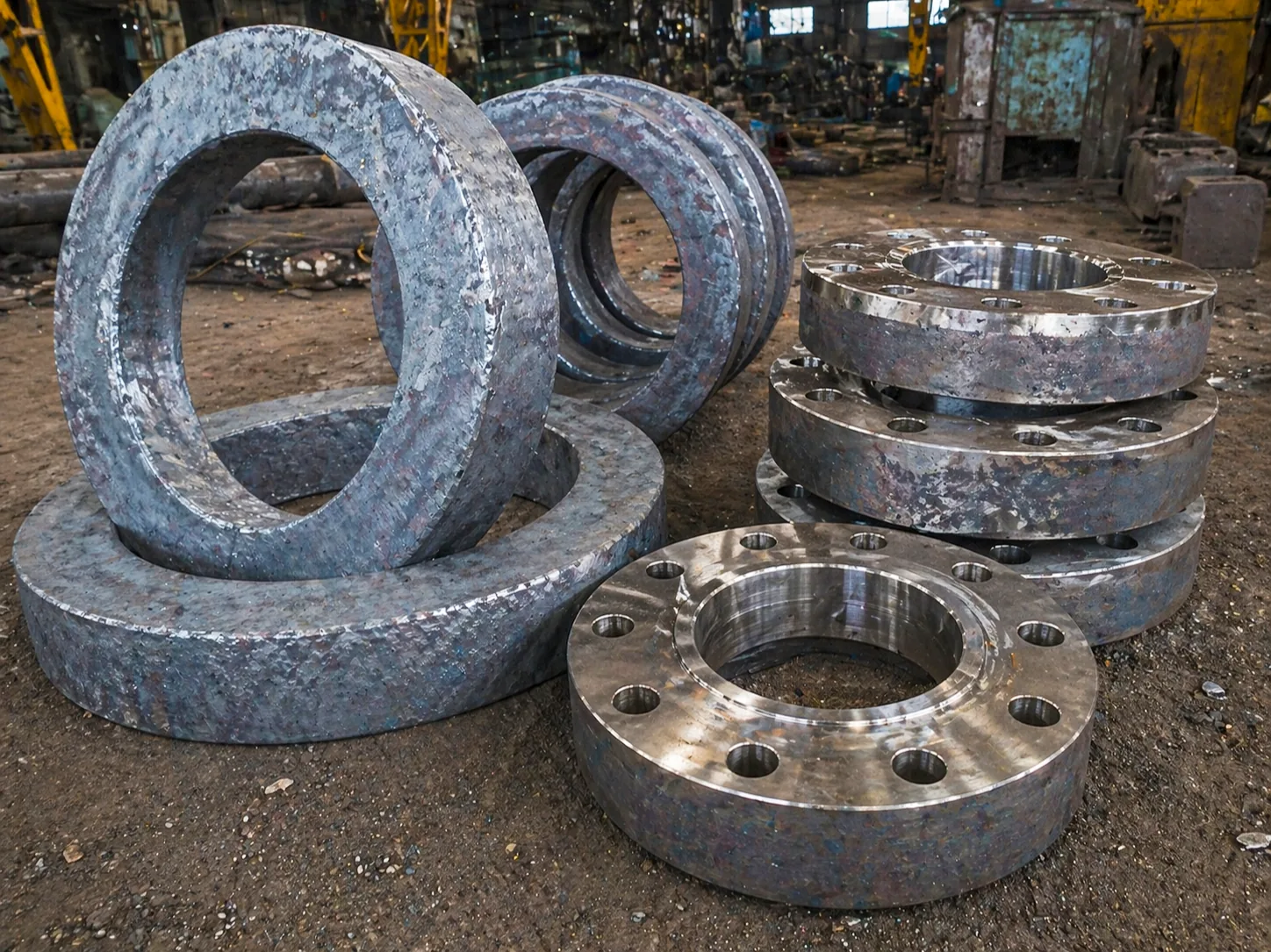
Forged Rings and Flanges: RFQ Quality Checklist addresses a practical specification decision for industrial buyers. The guidance below is intended to improve RFQ clarity and supplier comparison; the responsible engineering authority must approve design and acceptance requirements for the actual application.
Quick answer: A complete ring or flange RFQ defines finished and forging dimensions, grade, heat treatment, machining allowance, test methods, acceptance criteria, marking and documentation. Include the finished drawing and expected supply condition.
Forged rings and flanges can look simple on a drawing, but quotation scope changes significantly with diameter, wall thickness, height, contour, material, heat treatment and machining condition. A supplier quoting a rough ring is not offering the same scope as one quoting a finish-machined flange with drilled holes, UT, mechanical testing and full dimensional records.
A well-structured RFQ lets manufacturers assess starting stock, forging route, tooling, heat treatment and inspection before committing to price and lead time. It also gives the buyer a consistent basis for comparing technical offers.
Provide both finished and supply dimensions
Show finished outside diameter, inside diameter, height, wall transitions, faces, hubs and any contour. Then state whether the order is for an as-forged, proof-machined, rough-machined or finished component. If a separate forging drawing exists, include its revision and relationship to the finished drawing.
Identify machining stock on diameters and faces, and say whether values are radial or diametral. For contoured rings, show local allowances rather than a single general note that can be interpreted differently.
Define ring type and grain-flow objective
Clarify whether the part is a seamless rolled ring, open-die forged ring or another approved form. The selected route depends on geometry, quantity, available equipment and required properties. If circumferential grain flow is a design requirement, state the applicable standard or evidence needed rather than relying on marketing language.
Large hubs or asymmetric sections may need a tailored forging route. Send a three-dimensional model when it helps communicate the finished contour, but keep the controlled drawing as the acceptance authority.
Specify material without ambiguity
Give the standard, edition, exact grade, required condition and substitution rule. Include supplementary chemistry, cleanliness or source restrictions only when they are technically justified. If corrosion resistance is important, state the service environment so the design authority can confirm the grade.
For alloy steels, connect property requirements to finished section and heat treatment. For stainless grades, control identification and handling. Any equivalent grade should require written approval before material is purchased.
Connect heat treatment to final properties
State whether the component is normalized, annealed, quenched and tempered, solution treated or supplied in another condition. Define tensile, yield, elongation, impact, hardness or other properties with test locations and orientations as required by the standard.
Rings can respond differently at the surface and mid-wall. A coupon location should represent the required acceptance basis. If simulated heat treatment is permitted for test material, define the rules clearly.
Plan ultrasonic and surface examination
UT requirements should identify standard, acceptance class, coverage, scanning surfaces and reporting. Geometry can limit access near contours or hubs, so discuss excluded zones and the stage at which testing occurs. A proof-machined surface may improve examination compared with a scaled forging.
For ferromagnetic materials, MPI may be specified on machined surfaces or critical transitions. Stainless materials may require liquid penetrant testing where appropriate. Define acceptance and any permitted local dressing or re-examination.
Control flange features and datums
Finished flanges may include bolt circles, holes, raised faces, grooves, hubs and gasket-contact surfaces. Identify the primary datum face and axis. Relate hole position, face runout and concentricity to those datums. A bolt-circle diameter alone does not define positional accuracy.
If drilling is excluded from the forging supplier’s scope, preserve adequate stock and provide stable machining references. Clarify who performs final balancing or match marking for paired components.
State surface finish and preservation
Functional sealing faces and bearing locations may need specific roughness and protection. Non-functional surfaces can often use a less costly finish. Distinguish final machined requirements from temporary inspection surfaces.
Packaging should protect edges, sealing faces and corrosion-sensitive material. State whether export packing, desiccant, flange-face covers or special lifting points are required.
RFQ checklist for rings and flanges
- Finished drawing, model and forging drawing with revisions.
- Ring type, finished weight, forging weight and quantity.
- Material standard, grade, condition and substitution rule.
- Heat treatment and mechanical-property acceptance.
- Machining scope, allowances, datums and surface finish.
- UT, MPI or penetrant examination with acceptance levels.
- Dimensional report, material certificate and traceability.
- Marking, preservation, packing, destination and delivery date.
Compare quotations on the same basis
Create a bid-comparison table that separates material, forging, heat treatment, testing, machining, inspection, packing and freight. Ask each supplier to list deviations and exclusions. A lower price may simply omit finish machining, third-party inspection or a required certificate.
Check the proposed starting stock and lead-time assumptions. Material availability can drive schedule, especially for uncommon grades or very large sections. Confirm whether delivery time begins after drawing approval, advance payment or material release.
Questions buyers ask
Is a forged ring always seamless?
A seamless rolled ring is produced without a welded joint, but purchase documents should state the required product form and standard rather than assuming terminology.
Can one UT class be used for every ring?
No. The appropriate standard and acceptance level depend on design, material, geometry and customer requirements. They should be selected by the responsible authority.
Should bolt holes be included in the forging quotation?
Only if the requested scope says so. Make drilling, spot facing, threading and final inspection responsibilities explicit so quotations are comparable.
Request a ring or flange manufacturing review
Review the forged rings and flanges capability page and the quality-testing information. Then send the controlled drawings, material grade, quantity and inspection requirements to CS Heavy Forgings for a project-specific quotation review.
Technical note: Published values and examples support initial enquiry preparation. Final manufacturability, grade suitability, dimensions, testing and delivery must be confirmed against the controlled drawing and purchase specification.